Wednesday, January 28, 5-7 pm Millcreek City Hall 1330 East Chambers Avenue Millcreek, Utah
PLEASE PLAN TO ATTEND!
BACKGROUND:
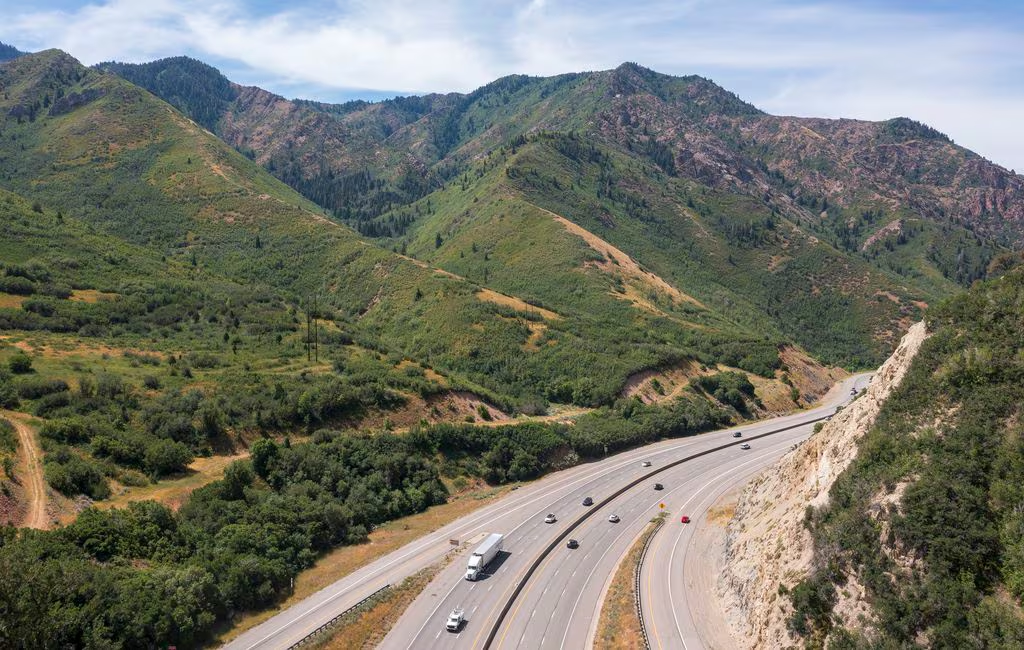
On August 8, 2025, Granite Construction submitted a “New Source Review Notice of Intention” (NSR NOI) to the Utah Division of Air Quality for a permit to generate air pollution from what they are now saying will be a 6 acre operation at the proposed I-80 South Quarry in Parleys Canyon.
This unexpected “start over” occurred nearly three years after Granite submitted their original air pollution permit request for a 20 acre quarry. That application had gone through extensive review, public comment, revision, further review, and, we were told, was on the cusp of being approved by DAQ. This reset has left everyone who has been monitoring this project scratching their heads.
In their new permit request Granite changed their proposal in the following ways:
- reduced the footprint of their initial excavation from 20 acres to 6 acres.
- reduced the amount of gravel generated per year from 1 million tons to 150,000 tons
- reduced the number of blasts per year from 12 to 5.
- reduced the hours of operation of their heavy equipment to the equivalent of 4 months of 8 hour days.
Additional information to be aware of that has occurred since the project was first proposed:
- Granite indicated in their initial hearings before the board of the Division of Oil, Gas, and Mining that their long term intention is to develop a 635 acre quarry in Parleys Canyon.
- Granite has spent significant funds this winter constructing a frontage road to the proposed quarry site, despite the fact that Salt Lake County has indicated that the 635 acre parcel of property is not eligible for a condition use permit to develop a quarry.
- The property owner, Tree Farm LLC, has challenged the County’s determination in Third District Court and recently filed a motion to extend discovery in the case and postpone scheduling the trial until March 7- the day after the legislature adjourns.
- HB 355, passed during the last legislative session, prohibits a local government from denying the expansion of an existing gravel pit onto property they already own. The bill’s sponsor, Rep. Casey Snider, said on the floor of the House that HB 356 was explicitly not intended to create an option for Granite to develop the gravel pit in Parleys Canyon.
This history of the Parleys gravel pit proposal, and these recent changes in the air pollution permit application, taken together raise many important questions that DAQ and other policy makers need to answer before any permits are issued by DAQ to Granite Construction:
Does DAQ have adequate information needed to determine the air quality impacts of Granite’s proposed gravel pit in Parleys Canyon?
- Does Granite have access to the amount of water required by the Division of Air Quality to suppress the dust that would have be generated by their initial operation plans?
- Since DAQ has no monitors east of 7th East that can measure the major air pollutants from a gravel pit (fugitive dust or PM 10), how can they assure the residents of the nearby Canyon Rim, Millcreek and Sugarhouse neighborhoods that the proposed Granite quarry, 2 miles up Parleys Canyon, won’t create unhealthy conditions for their families?
- Why does DAQ allow Granite to rely on wind data from the Salt Lake International Airport in modeling the dispersion of air pollutants generated in lower Parleys Canyon?
- Why hasn’t Granite been required to clarify what months they plan to operate the proposed 6 acre site so that DAQ can determine the air quality impacts during times of the year like this week when Granite’s emissions may push Salt Lake’s air quality even further into unhealthy levels?
Is Granite using gaps in the regulatory process to obscure their plans and incrementally develop a large gravel pit that would not be allowed if they were being transparent about their intentions?
- Is Granite trying to avoid DAQ scrutiny of the ultimate impact on air quality of their intended large operation by starting with very small one as way of establishing a foothold which would give them the right to expand into a much larger operation?
- Should Granite be required to reveal their full plans and air pollution estimates for the site before DAQ makes a decision on their air quality permit?
- Granite’s 6 acre quarry proposal does not appear to be financially feasible. Should DAQ require Granite to submit justification that the current proposal is economically viable before granting them a permit?
Why is DAQ being asked to issue a permit to an unnecessary project and before the court can rule on its eligibility for a local land use permit?
- Shouldn’t DAQ deny the permit in the face of two independent studies commissioned by Salt Lake County and the Utah Legislature, and released by Stantec last year, concluding that there is no need for additional gravel pits to support growth along the Wasatch Front during the next 10-15 years?
- Shouldn’t DAQ put the application on hold until there is a final ruling on Tree Farm’s court case with Salt Lake County?
WHAT YOU CAN DO.
- Attend the hearing on Wednesday and ask DAQ to postpone their decision on the permit until these and other questions can be answered,
- Submit written comments to DAQ at jpersons@utah.gov by Jan 31st outlining the reasons you oppose this proposed gravel pit and asking DAQ to deny the permit.
- Share this with family and friends who are concerned about Salt Lake’s air quality and ask them to attend the public hearing with you and submit comments.